
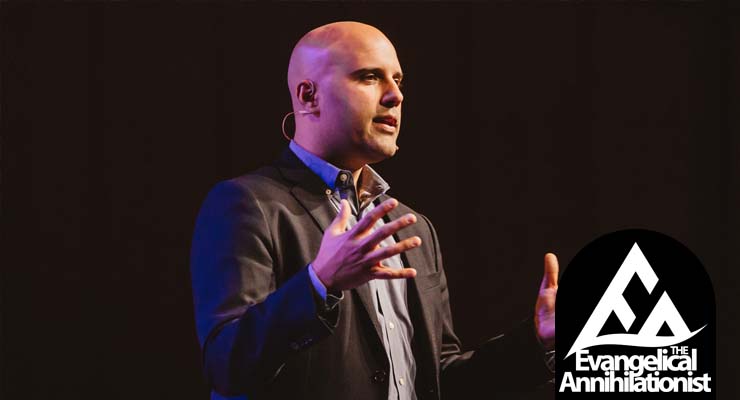
Recently, author, speaker, and podcast host Skye Jethani wrote a series of devotional articles about hell. Anticipating that his conditionalist understanding would be strange to many, he later arranged a live-streamed Q&A for his devotional subscribers, as well as all Holy Post Patreon supporters. (The Holy Post is the podcast that he co-hosts with Phil Vischer.) He spent a little over an hour responding to many of the questions that were submitted by his readers and listeners.
As I watched the live-stream, I was, on the one hand, pleased to hear him answer some difficult questions with clarity. On the other hand, I was somewhat disappointed by what I thought was a degree of disjointedness in some of his answers. The disjointedness, I think, can be seen in three broad ways.
Redefining Annihilationism
First, while he accepts the terms “conditional immortality” and “conditionalism,” he draws a sharp distinction between conditionalism and annihilationism. Though he clearly articulates the distinction, as he understands it, it is a distinction that most conditionalists probably will not draw. For the most part, conditionalists appear happy to be known as annihilationists, but Jethani speaks as if there is a sharp distinction between the two theologies. (I am sure that he is not the only one who draws this distinction, but I don’t think it is helpful.)
For Jethani, annihilationism is the view that there is no resurrection to judgment following biological death. Instead, biological death is the end of human existence. This is certainly the philosophical position of secular humanism, and it is the position held by certain cults, such as the Jehovah’s Witnesses. Most evangelical conditionalists, however, have no real problem being labelled annihilationists, even though they clearly affirm the general resurrection of the dead. The sharp distinction that Jethani draws, I think, is largely artificial and creates potential confusion.
Confusing Eternal
Second, near the beginning of the live-stream, Jethani answers a question about Matthew 25:46 by affirming that conditionalism does teach eternal punishment. On more than one occasion throughout the live-stream, he speaks of the “eternal” or “irreversible” punishment of death. At several points, however, he appears to contradict this.
For example, when his co-host asks him to clarify his disagreement with annihilationism (see above), the co-host offers the following as a summary of that disagreement: “The difference [between annihilationism and conditionalism] is that [in conditionalism] there is a punishment of some form or function that is not good—it’s a pretty bad punishment—but it eventually ceases. It comes to an end.” Jethani simply responds, “Yes.” But a punishment that comes to an end is, by definition, not eternal.
Later, in answering a question about weeping and gnashing of teeth, he stresses that there is suffering in the Bible’s vision of hell, but that suffering is proportional and will eventually come to an end. Again, eternal punishment, by definition, cannot come to an end.
Still later, a viewer poses the question, “Isn’t finite punishment the same as purgatory?” This seems to be a perfect opportunity for him to clarify that conditionalism does not teach finite punishment. Instead, he adopts the language of finite (or terminal) punishment but argues that this is not the same as purgatory.
When answering a still later question as to whether one convinced of conditionalism should leave a church that holds to eternal conscious torment, he replies that it depends on whether that church simply has the doctrine on the books or whether it is a prime driving factor behind that church’s evangelistic efforts. If the church’s focus is the centrality of Christ and his love, that, he says, is far more important “than this peripheral doctrine about, is it eternal conscious torment or temporal punishment?” He appears confused as to whether conditionalism teaches eternal or temporal punishment, whereas most evangelical conditionalists are quite plain that conditionalism affirms eternal punishment.
It appears that this confusion arises, as it so often does, by a misunderstanding of the nature of final punishment. Jethani appears to view the suffering preceding the second death as the punishment, which the second death brings to an end. This is what John Stackhouse refers to as “terminal punishment,” a term that Jethani refers to favorably. Scripture, on the other hand, does not teach that death brings the punishment of suffering to an end but that death is the punishment for sin. That penalty may or may not include suffering, but suffering is not itself sin’s punishment. Annihilation can only rightly be considered eternal punishment if the second death, which is irreversible, is itself the punishment for sin.
Motivating Evangelism
Third, Jethani stresses more than once that hell should not be the primary motivator in evangelism. Instead, he argues, evangelism should be driven by God’s love. He offers a twofold support for this.
First, he says, in the eight evangelistic sermons in Acts, which is the narrative of the apostles’ evangelistic ministry, hell is never mentioned. (He stresses this more than once throughout the stream.)
While he is undisputedly correct that the book of Acts never mentions hell—at least not by that name (though Acts 17:31 does speak of the “day when [God] is going to judge the world in righteousness”)—he at the same time fails to acknowledge that Acts also never mentions love. The word “love” is not found in Acts. If the absence of hell in Acts means that it shouldn’t drive our evangelism, is it not true, by the same logic, that the absence of love means that love shouldn’t drive our evangelism?
His second support for his affirmation that God’s love should drive our evangelism is Paul’s words in 2 Corinthians 5:14: “The love of Christ compels us.” Even if the apostles never mention love in Acts, surely this verse tells us explicitly what should drive our evangelism. However, in the same passage, Paul, having described the final judgment, writes, “Therefore, since we know the fear of the Lord, we try to persuade people” (2 Corinthians 5:6). In context, “the fear of the Lord” refers to the final judgment.
I do not mean to counter Jethani that fear of judgement, rather than the love of God, should drive our evangelism. I merely wish to show that the same arguments he supplies for minimizing hell in our evangelism can be applied to minimizing love in our evangelism. In reality, the repeated calls in Acts to repentance, and Paul’s warning in Acts 17:31 of a day of judgment, show that there is some validity to fear of judgment persuading people. But that in no way minimizes God’s loving offer of eternal life as a motivator for believing the gospel. In reality, God’s love and wrath are two sides of the same motivating coin when it comes to evangelism.
I am glad that Jethani has joined the line of conservative, evangelical voices that affirm and promote the biblical truth of conditional immortality, but I hope that he will work hard to be a little more careful in the way that he promotes conditionalism so as to minimize potential confusion over the topic.
Recent Comments